Best man speech template
PDF + editable Word doc · delivered instantly · 14-day refund, no questions
Six minutes, roughly, is what every experienced best man converges on: long enough to say something real, short enough that nobody's checking a watch. The hard part was never the jokes, it's the shape: what goes first, what the story actually needs to do, and how to land the toast so it feels like a landing, not an afterthought.
This guide gives you that shape, plus everything a blank document doesn't: how to get real material even if you don't already have it, exactly where a line from the free generator belongs, and how to deliver the whole thing so the room stays with you.
- The full five-part structure, with real timing for each section
- A scripted set of questions to ask the maid of honour, so you've got a genuine line about the couple together, not just the groom
- Exactly how to use the free generator on this site and where the line goes
- What to cut, what derails a room, and how to recover if a joke doesn't land
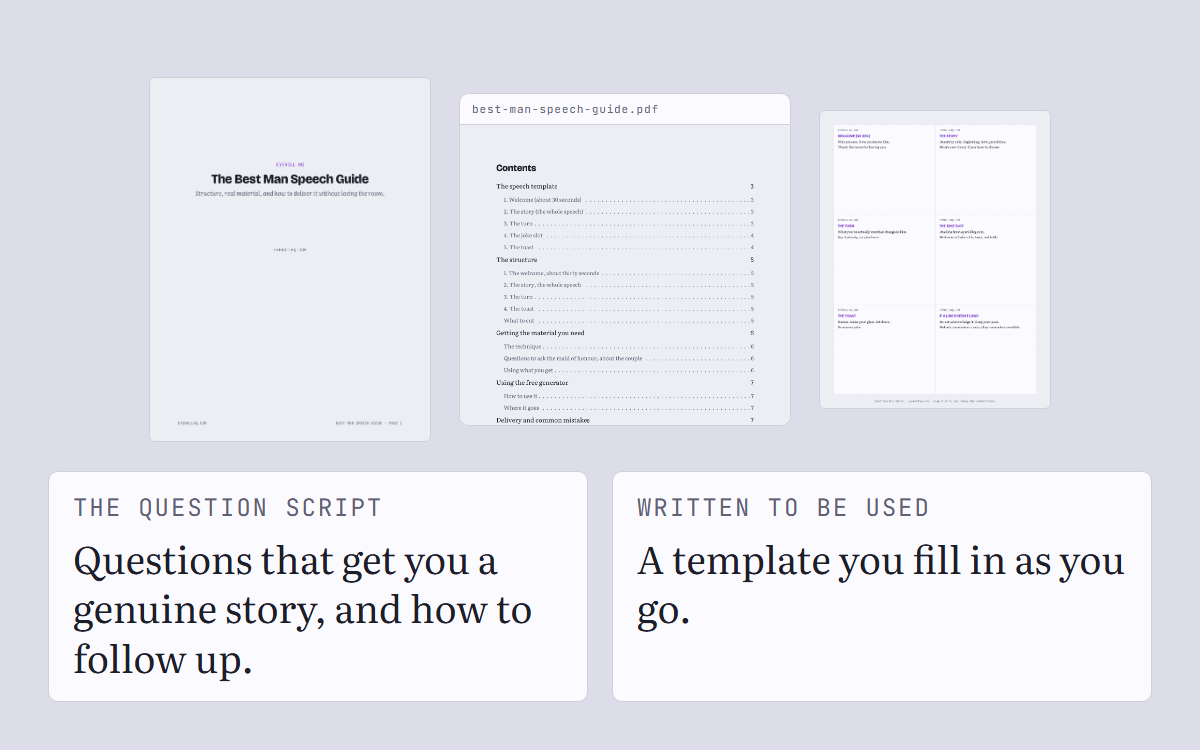
- Printable cue cards for the day itself
- Delivered as a full PDF guide and an editable Word document
Every wedding speech site hands you the same fifteen jokes: the ring joke, the stag-do photos, the one about him being whipped already. Say any of them out loud and half the room has heard it at someone else's wedding this year. This guide doesn't give you jokes. It gives you a way to get one true story out of the people who actually know him, so what you say is specific to your best man, not to weddings in general.
Contents
Everything below is in the one purchase, and every number here is a count of the real file, not a round figure.
- 01 A 9-page PDF guide: the speech template, the full five-part structure, the interview script, generator instructions, and delivery notes
- 02 5 interview questions to ask the maid of honour, so the turn has a real detail in it
- 03 6 printable cue cards for the day itself
- 04 1 editable Word document, the same speech template, ready to type into directly
PDF + editable Word doc · delivered instantly · 14-day refund, no questions
Not what you needed? Email within 14 days and I'll refund it. You keep the files.
How it works
- PayCard, Apple Pay or Google Pay. No account needed, just an email address.
- DownloadThe PDF guide and Word template land on the confirmation screen immediately, and in your inbox as a link that doesn't expire.
- Interview the maid of honourUse the script in the guide to get one real story about the couple, not a generic trait.
- Fill in the templateWrite the speech straight into the fill-in-blanks pages, or the Word doc if you'd rather type.
- Practice with the cue cardsPrint them, cut along the dashed lines, and run through it out loud before the day.
- Give the speechStructure done, material real, nerves the only thing left to manage.
Questions
How do I get it after I pay?
Instant download on the confirmation screen, plus emailed to you as a permanent link that never expires. No account needed to buy or to redownload later.
What formats do I get?
A 9-page PDF guide and an editable Word document, both included in the one purchase.
Can I actually edit it?
Yes. The Word document is a real editable template, not a locked PDF, so you can type directly into it, change the wording, or rework sections freely.
What if it's not right for me?
Email within 14 days and it's refunded, no questions asked. You keep the files either way.
Will it sound like a template?
Not if you use the interview script. The structure is the same for every speech, but the material inside it is one real story about your specific groom, gathered by asking the maid of honour the questions in the guide, so what you end up saying is yours, not generic.
The wedding is Saturday, is that too late?
No. Delivery is instant, so you can have the guide open and be writing within a minute of paying, even the night before.
Organising all the speeches? The Wedding Party Pack, all three wedding party guides plus the joke pack, is $39. Separately they are $66.